Showing posts with label nature. Show all posts
Showing posts with label nature. Show all posts
09 November 2013


07 October 2013
Giant Hornets Are Killing People In China

... According to recent reports out of China, 21 people have died as a result of wasp stings over the past three months in the province of Shaanxi alone ... This year, the hornet attacks in China have been more frequent than usual; one health official suggested to the AP that warmer temperatures have led to increased breeding among the insects. The mayor of one affected city in Shaanxi announced last week plans to establish a 24-hour emergency response team to combat hornets in light of the recent fatalities. Wasp season in China runs from May to November.Gawker
And CNN distinguishes itself again.

12 September 2013
Microcosmos | 'Beauty Too Small To See With The Naked Eye'
 |
| Link |
The spectacular visuals were captured using a variety of traditional light-based microscopes, powerful scanning electron microscopes which bombard the subject with electrons and build the image using a computer and transmission electron microscopes.

Chloroplasts in plant cells

Household dust

Butterfly eggs on a raspberry plant

Needle and thread

Marijuana

Wood ant holding a microchip

Velcro

Beard hair cut with a razor (left) and with an electric shaver (right)
Click images to enlarge | DSLR Imagery via i09
14 March 2013
Amazon | Catch & Release Spider Thingee

The perfect gadget for kids who want to catch and study insects or for anyone who needs to get rid of a bug without touching or killing it. Plastic, long-handled tool has fiber-optic bristles that open and close with a squeeze of the trigger. It's designed to trap and remove spiders, moths, bees and other insects from a safe distance quickly, cleanly and without harm. At about 26" long, you'll be able to grab bugs hiding in hard-to-reach places.Only $9.99
For tomB
29 January 2013
Cuddly Killers

In a report that scaled up local surveys and pilot studies to national dimensions, scientists from the Smithsonian Conservation Biology Institute and the Fish and Wildlife Service estimated that domestic cats in the United States — both the pet Fluffies that spend part of the day outdoors and the unnamed strays and ferals that never leave it — kill a median of 2.4 billion birds and 12.3 billion mammals a year, most of them native mammals like shrews, chipmunks and voles rather than introduced pests like the Norway rat.
The estimated kill rates are two to four times higher than mortality figures previously bandied about, and position the domestic cat as one of the single greatest human-linked threats to wildlife in the nation. More birds and mammals die at the mouths of cats, the report said, than from automobile strikes, pesticides and poisons, collisions with skyscrapers and windmills and other so-called anthropogenic causes. Peter Marra of the Smithsonian Conservation Biology Institute and an author of the report, said the mortality figures that emerge from the new model “are shockingly high ... When we ran the model, we didn’t know what to expect.” Marra, who performed the analysis with his colleague, Scott R. Loss, and Tom Will of the Fish and Wildlife Service [added] “We were absolutely stunned by the results.”New York Times via Jezebel
05 August 2012
Orphaned Kangaroo Comforted By Orphaned Wombat


Anzac, an orphaned baby kangaroo, was placed with Peggy, a wombat, and the two now sleep together in the same pouch. Lisa Milligan, from the Wild About Wildlife Kilmore Rescue Center [Australia], said the unlikely friends were comforted by each other's movement and heartbeat.
I just love the pics.
Link via Arbroath
21 May 2012
Too Much Nature | Golden Eagle Grabs Photographer's Knife

Click image to enlarge
Photographer Han Bouwmeester, hoping to attract birds of prey with cut-up chunks of meat, got a great shot when a golden eagle flew off with his knife.
Daily Mail
13 May 2012
12 July 2011
When I Heard The Learn'd Astronomer
I've been watching the third season of the excellent AMC drama Breaking Bad and was moved by Gale's recitation of this poem while he and Walt were bonding in the new meth lab. Both are men of science and believe that "chemistry is magic." I've always thought that the poem means that man cannot control nature, that each being perfects him- or herself through communion with nature, and that the rigidity and precision of science can suck the beauty right out of the natural world.
When I Heard the Learn'd Astronomer
Walt Whitman (1864)
When I heard the learn'd astronomer;
When the proofs, the figures, were ranged in columns before me,
When I was shown the charts and the diagrams, to add, divide, and
measure them,
When I sitting heard the astronomer where he lectured with much applause in the lecture-room,
How soon, unaccountable I became tired and sick,
Till rising and gliding out I wander'd off by myself,
In the mystical moist night-air, and from time to time,
Look'd up in perfect silence at the stars.
Whitman wrote this poem in 1864. It was published in the 1881-82 edition of Leaves of Grass.
11 May 2011
Bios Urn

An eco-friendly urn offers people who decide to be cremated the opportunity to give back to Earth with their remains – literally. Designed and created by Spanish designer Martín Ruiz de Azúa, who lives in Barcelona, the Bios Urn allows people to have their ashes eventually grow into a tree.Arbroath
20 April 2011
io9 | 25 Great Books By Legendary Scientists

#1. The Origin of Species by Charles Darwin
Alasdair Wilkins writes:
... here are twenty-five amazing books written by world-famous scientists. These are legendary texts, popular science explainers, personal memoirs, and controversial new theories, and they're all enduring monuments to the power of science.The list includes books by James Watson, Jonas Salk, Richard Feynman, Margaret Mead, Jane Goodall, Richard Dawkins, Mary Leakey, and Primo Levi. The only nits I have to pick are the inclusion of The Basic Writings of Sigmund Freud [I would nominate the two-volume Principles of Psychology by William James instead] and the absence of Thomas Kuhn's The Structure of Scientific Revolutions.
Read the article and see the complete list at io9.
18 April 2011
17 January 2011
Essay | Shaun Ellis - Man Among Wolves

Shaun Ellis
Photograph by Harry Borden for The Guardian
I grew up in a small village in Norfolk and was always interested in the natural world and wild animals. I knew I wanted to work with them in some way when I was older. In my 20s, I read about an American naturalist, Levi Holt, who ran a wolf research centre in Idaho and I thought, "That's where I want to go." I sold everything I had and raised enough money for my plane fare. When I met up with biologists working on the reservation, they took me on as a basic field biologist, teaching me how to track wolves and collect data for them.• As told to Fiona Clampin | The Guardian
Even though the other biologists and scientists thought it was dangerous, I soon wanted to get closer to the wolves really to understand their behaviour. I couldn't help wondering, "Could a human become part of their family?" If I could, I thought, imagine what information I could share.
After a year or two of working for the centre and getting to know the area – a rugged, mountainous landscape covered in forest – I moved to the wild. The first time I got up close to a wolf, within around 30 metres, any fear I had quickly turned to respect. I stayed in a den area, a remote spot where wolves look after their young, and very soon one pack began to trust me. I lived with them day and night, and from the start they accepted me into their group. I ate what they ate, mostly raw deer and elk, which they would often bring back for me, or fruit and berries. I never fell ill and my body adapted quickly to its new diet. It's easy to look back and think, "What horrible food", but when you haven't eaten for a week, it looks appetising.
I couldn't hunt, but I soon became useful looking after the younger ones. I would spend days sitting outside the den, observing their behaviour and trying to make sure they kept out of danger.
I stayed with the same pack for over a year, watching pups grow to adulthood. I never missed human contact during that time.
I felt a tremendous sense of belonging with the wolves. Whenever I began to think about my old life, I would quickly switch my thoughts back; in terms of survival, I had constantly to focus on my new habitat. Although I didn't see anyone, there were people back at the reservation and I had a rendezvous point where I could leave messages if I felt I was in danger. I was only ever truly scared on two occasions: once, when all the wolves were feeding, I ate the wrong piece of meat – there is a strict hierarchy of who eats what part of an animal – and one of the wolves leapt on me in seconds because of my mistake. He took my entire face in his mouth and started to squeeze hard. I could feel the bones in my jaw begin to bend, and in that split-second I realised how vulnerable I was and how restrained they were most of the time.
The other time, I wanted to get a drink from the stream and one of the wolves stopped me dead in my tracks, growling, snarling and nipping me. I thought, "This is the end, he's going to finish me off." An hour or so later, he started to lick my face and we both went to the stream for a drink. There I saw evidence of recent bear tracks and droppings, and I realised this was why he guarded me. I would almost certainly have been killed but, more importantly, my tracks would have led back to their young, so it was for their protection.
Eventually I had to leave; I had lost so much weight and looked gaunt and worn after a year . Life expectancy in that sort of environment was short and I felt it was time to come back to society. Returning to the world was a tremendous culture shock, but I knew I could do a lot with the knowledge I'd acquired. I now run a centre in Devon that helps wild and captive wolves, and offers educational courses. I want to show people that wolves aren't savage and ruthless – they are balanced and trustworthy creatures that place their family above all else.
YouTube
05 January 2011

23 December 2010
How Reindeer Really Learned How To Fly

... There is evidence from around the world of animals deliberately consuming [hallucinogenic] plants, and legends about plants used in sacred rituals often include references to animals introducing them to mankind.More at The Pharmaceutical Journal and The Magpie's Hoard.
One such species, appropriately for a Christmassy article, is the reindeer, which goes to great lengths to search out the hallucinogenic fly agaric mushroom (Amanita muscaria) — the one with the white-spotted red cap that garden gnomes like to sit on. Eating the toadstool makes reindeer behave in a drunken fashion, running about aimlessly and making strange noises. Head-twitching is also common.
Fly agaric is found across the northern hemisphere and has long been used by mankind for its psychotropic properties. But its use can be dangerous because it also contains toxic substances. Reindeer seem to metabolise these toxic elements without harm, while the main psychoactive constituents remain unmetabolised and are excreted in the urine. Reindeer herders in Europe and Asia long ago learnt to collect the reindeer urine for use as a comparatively safe source of the hallucinogen.
Via Gawker
21 December 2010
01 October 2010
Chinar Leaf Carving

Natural leaf carving is actual manual cutting and removal of a leaf's surface to produce an art work on a leaf. The process of carving is performed by artists using tools to carefully remove the surface without cutting or removing the veins. The veins add detail into the subject matter of the carving. The most common leaf used ... is the leaf of a Chinar tree. The Chinar tree is native to India, Pakistan and China. Chinar leaves have a close resemblance to maple leaves.Longal Craft via TDW
27 September 2010
The Moeraki Boulders | New Zealand


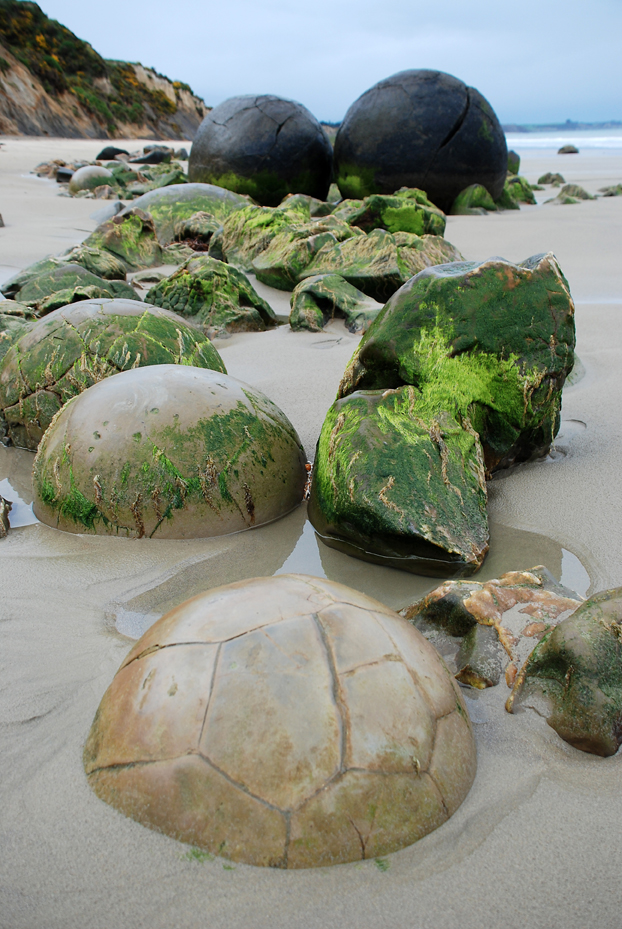
If you go down to Koekohe beach in New Zealand you can be sure of a big surprise. In front of you, scattered like enormous marbles from some long abandoned game between giants, are hundreds of giant spherical rocks ... The Moeraki boulders present us with a mystery – what are they and how on earth did they get there?More beautiful photographs and some informaton about the age of the boulders and how they were formed at Kuriositas.
24 July 2010
A History Of Mass Extinctions On Earth

Stephanie Fox | io9
Click image to enlarge
During [the] long history of planet Earth, massive extinctions and violent climate changes are the norm. We've created this infographic to help you chart the rise and fall and rise of life on Earth over the past few billion years.io9
Humans may have evolved during an unusual period of relative climate stability (despite those ice ages). What you see here are the biggest mass extinctions in Earth history and their places in the major geological ages of Earth. We've also got body counts - the line graph in the middle shows you how many species survived, which in some cases is nearly zero.
14 June 2010
Greenaid | Put SeedBomb Vending Machines In Your Community

Made from a mixture of clay, compost, and seeds, "seedbombs" are becoming an increasingly popular means combating the many forgotten grey spaces we encounter everyday-from sidewalk cracks to vacant lots and parking medians. They can be thrown anonymously into these derelict urban sites to temporarily reclaim and transform them into places worth looking at and caring for. The Greenaid dispensary simply makes these guerilla gardening efforts more accessible to all by appropriating the existing distribution system of the quarter operated candy machine.
The Common Studio via The Daily What
Subscribe to:
Posts (Atom)